Table of Contents
Enterprise System Integration Consulting | Hybrid Architecture | Sandhata
Modern enterprise organizations rely on hundreds of specialized software applications to run their daily operations. Over decades of organic growth, corporate mergers, and rapid cloud adoption, large enterprises have accumulated a complex mix of public cloud microservices, third-party SaaS platforms, customer relationship management tools, enterprise resource planning systems, payment gateways, and core legacy mainframes.
However, owning powerful individual applications does not guarantee business agility. When critical customer data remains trapped inside isolated system silos, business processes slow down, customer experiences become fragmented, and launching new digital products takes months of custom engineering.
Consider a routine customer interaction at a global bank or telecommunications provider: a customer updates their address or submits a service request on a mobile app. Behind the scenes, that single update must flow securely across cloud API gateways, CRM platforms, billing engines, fraud monitoring systems, and core mainframe ledgers in real time. When systems rely on fragile point-to-point connections or slow overnight batch file transfers, data falls out of sync, transactions fail, and operational costs skyrocket.
Enterprise System Integration Consulting resolves these structural challenges. By designing resilient, API-led, and event-driven integration architectures, organizations connect cloud platforms, modern microservices, and legacy mainframes into a unified, real-time digital nervous system.
This comprehensive guide explores why legacy integration patterns fail at enterprise scale, the foundational pillars of modern hybrid integration engineering, and how Sandhata Technologies helps global enterprises build scalable, secure, and high-velocity connected ecosystems.
Section 1: Why Legacy Integration Architectures Fail Modern Enterprises
Understanding the structural weaknesses of outdated connectivity models is essential for building an agile, future-proof enterprise architecture.
1.1 The Maintenance Trap of Point-to-Point Spaghetti
In the absence of a centralized integration strategy, engineering teams connect applications directly to one another using custom scripts, hardcoded database links, and ad-hoc file transfers.
While building a single point-to-point connection between two applications is fast initially, the complexity grows exponentially as new systems are added. Connecting just twenty applications point-to-point creates hundreds of tangled dependencies. Whenever a vendor updates a SaaS API or an internal team upgrades a database, dozens of undocumented connections break simultaneously, trapping IT teams in endless reactive maintenance.
1.2 Heavy, Monolithic Enterprise Service Buses (ESBs)
To escape point-to-point chaos, many organizations deployed centralized Enterprise Service Buses (ESBs) fifteen years ago. Over time, business logic became tightly embedded inside massive, monolithic ESB servers.
Today, legacy ESBs frequently act as single points of failure and severe scaling bottlenecks. Updating a single routing rule requires coordinated downtime across multiple business units, preventing agile cloud teams from deploying independent updates rapidly.
1.3 Slow Overnight Batch File Transfers vs. Real-Time Customer Expectations
Legacy systems frequently exchange data using scheduled overnight batch jobs that transfer flat files via FTP. In an era of instant digital payments, real-time inventory tracking, and immediate customer onboarding, waiting twenty-four hours for batch files to process creates unacceptable delays and stale customer records across channels.
1.4 The Hybrid Divide Between Cloud Agility and Legacy Mainframes
Established banks, insurance carriers, and telecom providers operate mission-critical business logic on IBM Z mainframes alongside agile cloud platforms. Translating modern RESTful JSON payloads into fixed-length COBOL copybooks and EBCDIC formats requires specialized integration engineering. Without clean abstraction layers, cloud squads get bogged down by mainframe complexities, driving up expensive mainframe CPU consumption (MIPS).
Section 2: Core Engineering Pillars of Sandhata’s System Integration Consulting
Sandhata Technologies brings over two decades of specialized enterprise integration, middleware, and DevOps engineering experience to help global organizations modernize connectivity across six core pillars.
2.1 Pillar 1: Three-Tier API-Led Connectivity Architecture
Sandhata eliminates point-to-point spaghetti by organizing enterprise integration into three clean, reusable architectural layers:
- System APIs: Unlock data from core systems of record—such as IBM mainframes, SAP ERP platforms, and legacy databases—hiding underlying technical complexity behind standardized, secure REST or GraphQL interfaces.
- Process APIs: Combine and orchestrate data from multiple System APIs to execute core business workflows—such as customer onboarding, credit checks, or order fulfillment—independent of front-end channels.
- Experience APIs: Tailor and format data specifically for end-user channels—such as mobile apps, web portals, and partner APIs—allowing front-end teams to innovate rapidly without modifying backend core systems.
This layered approach maximizes component reuse across projects, slashing integration delivery time by up to sixty percent.
2.2 Pillar 2: Event-Driven Architecture and Real-Time Data Streaming
To replace slow overnight batch transfers with instant responsiveness, Sandhata designs Event-Driven Architectures powered by Apache Kafka, IBM MQ, and cloud event buses.
Instead of systems constantly polling one another for updates, applications publish immutable business events—such as Payment Settled, Policy Issued, or Address Updated—the millisecond a change occurs. Downstream microservices, analytics engines, and notification platforms subscribe to relevant event streams and react in real time, ensuring total data consistency across the enterprise without tight coupling.
2.3 Pillar 3: Hybrid Cloud-to-Mainframe Integration and MIPS Optimization
Sandhata specializes in connecting modern cloud platforms (AWS, Microsoft Azure, Google Cloud) seamlessly with legacy IBM Z mainframes.
Using z/OS Connect APIs, IBM MQ messaging bridges, and real-time Change Data Capture (CDC) pipelines, Sandhata exposes mainframe CICS transactions and DB2 data safely to cloud applications. By introducing intelligent caching layers and event-driven read replicas in the cloud, Sandhata reduces repetitive read queries hitting the mainframe, cutting expensive MIPS consumption substantially.
2.4 Pillar 4: Legacy ESB Modernization and Cloud iPaaS Migration
Sandhata helps organizations decompose bloated legacy Enterprise Service Buses into lightweight, containerized integration microservices and modern cloud Integration Platform as a Service (iPaaS) solutions.
Decomposing monolithic middleware eliminates central scaling bottlenecks, enables independent deployments per business domain, and allows organizations to leverage elastic cloud auto-scaling during peak transaction surges.
2.5 Pillar 5: Automated Integration Testing and Service Virtualization
Integration architectures are only as reliable as their validation pipelines. Sandhata embeds automated quality engineering directly into every integration project.
Using Consumer-Driven Contract Testing, automated Kafka and IBM MQ message validation, and enterprise Service Virtualization, Sandhata verifies schema transformations, error dead-letter queues, and fault recovery workflows continuously inside CI/CD pipelines—catching interface bugs before they ever reach production.
2.6 Pillar 6: Zero-Trust API Security and Regulatory Governance
In regulated industries such as banking and healthcare, every integration endpoint is a potential security perimeter. Sandhata implements Zero-Trust API governance across all gateways and message brokers—enforcing OAuth 2.0 and OpenID Connect authentication, mutual TLS encryption, automated rate-limit throttling, sensitive PII payload masking, and tamper-proof audit trails required by DORA, FCA/PRA rules, PCI-DSS, and GDPR.
Section 3: Evaluating Integration Maturity with the Maturity Compass
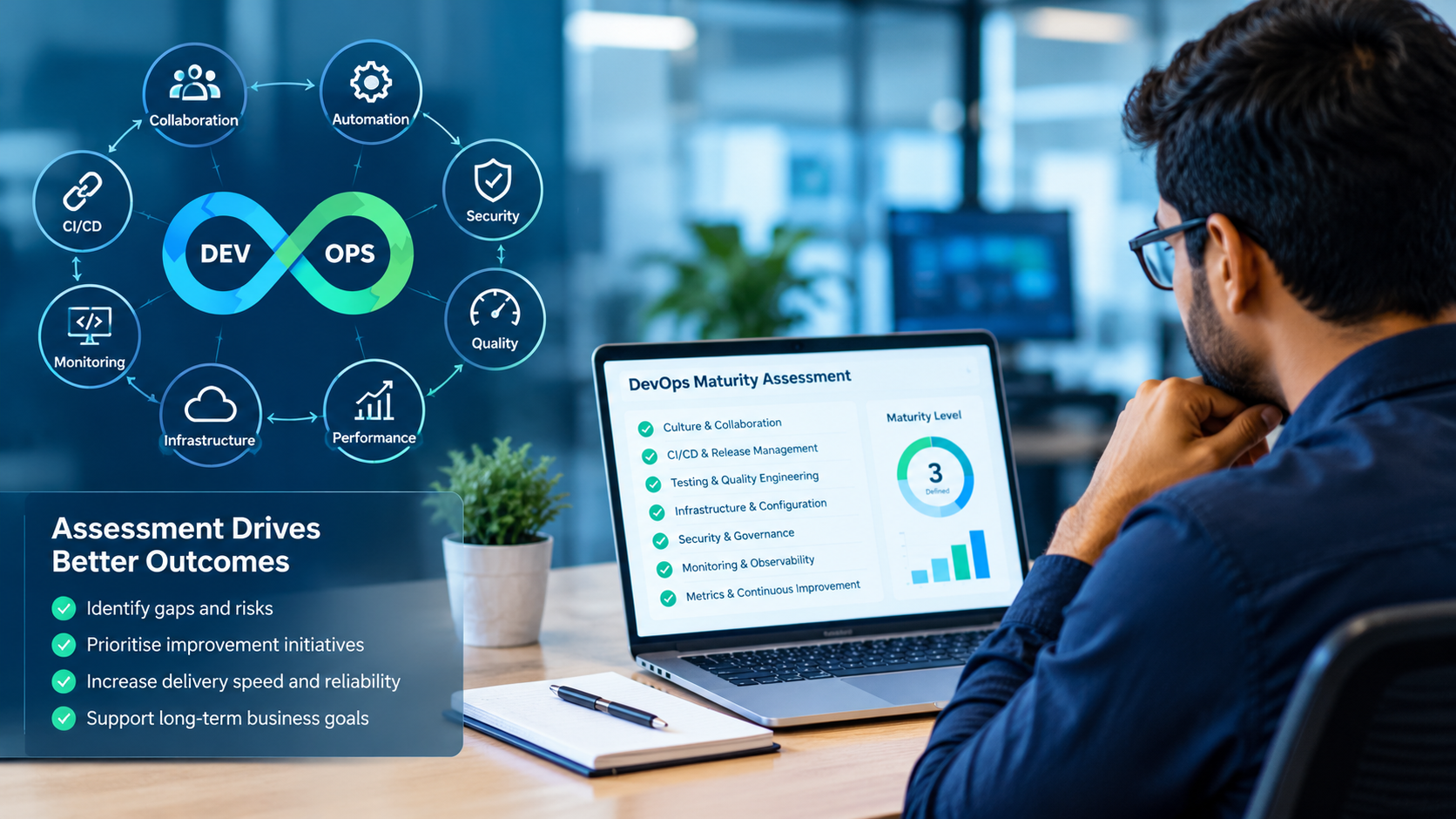
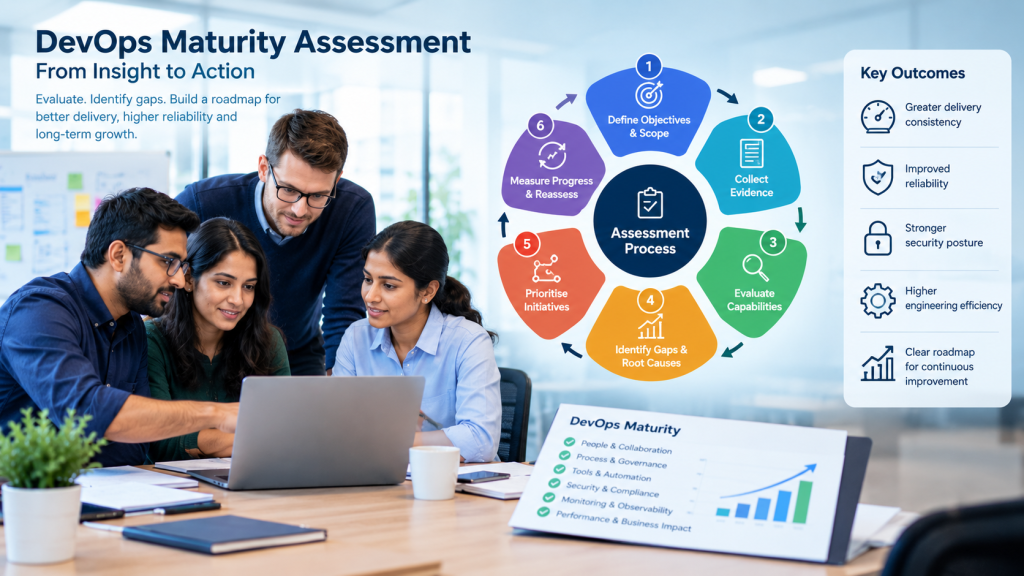
Sandhata applies the proprietary DevOps & SRE Maturity Compass to help technology leaders audit their current integration landscape across 30 to 40 technical, operational, and governance dimensions.
Level 1: Point-to-Point Spaghetti and Overnight Batching. Applications connect via undocumented custom scripts, direct database links, and overnight file transfers. Upgrades break multiple systems, data is frequently out of sync, and integration delivery takes months.
Level 2: Centralized Monolithic ESB. Systems connect through a heavy central service bus. While point-to-point chaos is reduced, the central ESB acts as a scaling and deployment bottleneck, and legacy mainframes remain difficult to access from cloud apps.
Level 3: API-Led Connectivity and Hybrid Cloud Integration. The enterprise operates a governed API management layer separating System, Process, and Experience APIs. Cloud microservices connect cleanly to mainframes via z/OS Connect and IBM MQ, and automated contract tests run inside CI/CD pipelines.
Level 4: Autonomous Event-Driven and Hyperautomated Ecosystem. Real-time Kafka event streaming and Change Data Capture synchronize data instantaneously across multi-cloud and mainframe estates. Containerized integration runtimes scale elastically, Service Virtualization decouples testing, and Sandhata’s ATOM2 hyperautomation platform orchestrates continuous end-to-end validation.
The Maturity Compass gives executive leadership objective benchmark scores and a clear, phased roadmap for modernizing enterprise connectivity.
Section 4: Enterprise Impact – Real-World Integration Consulting Case Studies
Case Study 1: Global Retail Bank Unifies Cloud Digital Channels with Core Mainframes
A tier-1 global retail bank struggled to launch new mobile banking features quickly because customer data was fragmented across legacy IBM mainframes, an aging monolithic ESB, and over one hundred cloud microservices. Building a single new product integration required four months of custom middleware coding and manual testing.
Sandhata deployed a team of Enterprise Integration Architects and Middleware Engineers to modernize the bank’s integration platform. Sandhata designed a three-tier API-Led Connectivity architecture, implemented z/OS Connect gateways and IBM MQ event bridges, and embedded automated contract testing and Service Virtualization into CI/CD pipelines.
Integration delivery lead time dropped by seventy-five percent, falling from four months down to under four weeks. API reuse across mobile and web channels exceeded eighty percent, non-production mainframe MIPS costs dropped by thirty-two percent, and system availability remained at 99.999 percent during peak payment periods.
Case Study 2: Major European Telecommunications Provider Migrates from Legacy ESB to Event-Driven Cloud
A multinational telecommunications provider faced recurring outages and scaling limits on its legacy Enterprise Service Bus during peak subscriber promotions. Batch file delays between its web storefront, CRM platform, and billing mainframe caused customer activation errors and high support call volumes.
Sandhata engineered a cloud-native Event-Driven Architecture powered by Apache Kafka, real-time Change Data Capture, and containerized integration microservices.
Order-to-activation processing times dropped from hours to under three seconds, integration-related customer support tickets fell by eighty-eight percent, and elastic cloud scaling cut annual middleware licensing and infrastructure costs by forty percent.
Section 5: Essential Metrics for Enterprise System Integration Success
Measuring the strategic return on investment of Enterprise System Integration Consulting requires tracking objective operational metrics across agility, reliability, and cost efficiency:
API and Integration Asset Reuse Rate: Measuring the percentage of System and Process APIs reused across multiple digital channels and business projects, targeted above 70 percent.
Integration Delivery Lead Time: The total elapsed time required from defining an integration requirement to deploying a tested, production-ready API or event stream, reduced from months to weeks.
End-to-End Transaction Latency: Measuring real-time message propagation speed across cloud gateways, middleware brokers, and backend mainframes.
Integration Failure Rate: Tracking the percentage of transactions failing due to schema mismatches, timeouts, or routing errors, targeted below 0.01 percent.
Mainframe MIPS and Middleware Cost Reduction: Quantifying infrastructure and licensing savings achieved through API caching, event-driven replication, and legacy ESB decommissioning.
Section 6: Frequently Asked Questions (FAQs)
FAQ 1: What is Enterprise System Integration Consulting?
Enterprise System Integration Consulting is a specialized architectural and engineering service that helps large organizations connect disconnected software applications, cloud platforms, databases, third-party SaaS tools, and legacy mainframes into a unified, real-time digital ecosystem.
FAQ 2: Why do enterprise organizations struggle with fragmented IT systems?
Over decades of growth, mergers, and cloud adoption, enterprises accumulate hundreds of separate applications that do not communicate naturally. Without modern integration architecture, teams rely on fragile point-to-point connections and slow overnight batch file transfers, creating data silos and operational bottlenecks.
FAQ 3: What is API-Led Connectivity and how does it improve enterprise agility?
API-Led Connectivity organizes integration into three reusable layers: System APIs that unlock data from core databases and mainframes, Process APIs that combine data into business workflows, and Experience APIs that tailor data for mobile apps and web portals. This eliminates duplicate work and speeds up new product launches.
FAQ 4: How does Event-Driven Architecture differ from traditional request-response APIs?
Traditional APIs require one system to ask another system for data and wait for an immediate reply. Event-Driven Architecture uses streaming brokers like Apache Kafka and IBM MQ to broadcast business events instantly whenever data changes, allowing multiple systems to react in real time without tight coupling.
FAQ 5: Can Sandhata integrate modern cloud microservices with legacy IBM Z mainframes?
Yes. Sandhata specializes in hybrid cloud-to-mainframe integration, using z/OS Connect APIs, IBM MQ messaging bridges, and modern data streaming tools to connect legacy COBOL, CICS, and DB2 systems seamlessly with AWS, Azure, and Google Cloud platforms.
FAQ 6: What is the danger of point-to-point integration spaghetti?
When organizations connect systems directly one-to-one without a central integration layer, the number of custom connections grows exponentially. Changing a single database or upgrading one application breaks dozens of fragile links, making maintenance expensive and risky.
FAQ 7: How does Sandhata modernize legacy Enterprise Service Buses (ESBs)?
Sandhata helps enterprises migrate away from heavy, monolithic legacy ESBs toward lightweight, cloud-native microservices, containerized integration runtimes, and modern Integration Platform as a Service (iPaaS) solutions that scale elastically.
FAQ 8: How does automated testing and Service Virtualization support system integration projects?
Sandhata pairs integration engineering with automated API contract testing and Service Virtualization, allowing teams to verify message routing, schema transformations, and error recovery continuously in CI/CD pipelines before production deployment.
FAQ 9: How does Enterprise System Integration support regulatory compliance like DORA and Open Banking?
Modern integration platforms enforce centralized OAuth security, mutual TLS encryption, rate limiting, and immutable transaction audit trails across every API and message flow, ensuring compliance with DORA, FCA/PRA resilience rules, PSD2, and GDPR.
FAQ 10: What role does Sandhata’s ATOM2 platform play in enterprise integration?
Sandhata’s ATOM2 hyperautomation platform accelerates integration delivery and validation by providing pre-built connectors, automated end-to-end workflow testing, and centralized observability across hybrid cloud and legacy environments.
FAQ 11: How does Enterprise System Integration reduce mainframe MIPS consumption?
By introducing intelligent API caching layers and event-driven data replication, modern integration architectures serve repetitive read queries from fast cloud stores instead of repeatedly querying core mainframes, lowering expensive MIPS usage.
FAQ 12: What is Change Data Capture (CDC) in real-time enterprise integration?
Change Data Capture monitors database transaction logs in real time and streams inserts, updates, and deletes immediately to downstream analytics platforms, search indexes, and cloud microservices without placing heavy query loads on core databases.
FAQ 13: What key metrics measure the success of Enterprise System Integration Consulting?
Key metrics include API Reuse Rate, Integration Delivery Lead Time, End-to-End Transaction Latency, Integration Failure Rate, and Mainframe MIPS Cost Reduction.
FAQ 14: How does Sandhata assess an organization’s current integration maturity?
Sandhata applies the proprietary DevOps & SRE Maturity Compass alongside comprehensive architectural audits to evaluate API governance, middleware scalability, hybrid connectivity, and pipeline automation across 30 to 40 technical criteria.
FAQ 15: How long does an Enterprise System Integration Consulting engagement take with Sandhata?
Initial architectural assessments and roadmap design require 2 to 4 weeks. Implementing core API gateways, event-driven streaming pipelines, and hybrid mainframe connectors delivers measurable operational improvements within 8 to 12 weeks.
Strategic Recommendation and Next Steps
Allowing critical enterprise systems to remain trapped behind fragile point-to-point connections, aging monolithic service buses, and slow overnight batch transfers prevents organizations from delivering seamless digital customer experiences and slows down cloud modernization. To thrive in fast-moving digital markets, technology leaders must establish a clean, reusable, and real-time integration foundation.
Enterprise System Integration Consulting provides the architectural blueprint for a connected enterprise. By implementing API-Led Connectivity, adopting real-time Apache Kafka and IBM MQ event streaming, bridging cloud microservices with core mainframes, and automating contract testing across CI/CD pipelines, organizations accelerate innovation while reducing operational risk.
Sandhata Technologies brings over two decades of proven engineering excellence in enterprise integration, middleware modernization, and DevOps transformation across heavily regulated global industries.
Contact Sandhata’s Enterprise Integration Architects today to schedule your DevOps & SRE Maturity Compass Assessment and connect your digital ecosystem for speed and resilience.