Table of Contents
24/7 Lift Breakdown Service Hyderabad | Urgent Emergency Repairs
When a vertical transportation system suffers a sudden operational failure within a high-density urban corridor, it triggers an immediate logistical crisis. Unlike scheduled preventive maintenance, an emergency lift breakdown is a time-critical event. It demands rapid diagnosis, strict adherence to high-voltage electrical safety rules, and precise mechanical interventions.
In a major commercial and residential hub like Hyderabad—where rapid real estate development has created vast networks of high-rise IT towers, sprawling corporate campuses, and densely populated apartment complexes—a stalled elevator causes immediate disruption. It compromises building accessibility, risks trapping passengers, and exposes building management to serious regulatory liabilities if emergency safety links fail to function.
Securing a highly specialized, certified lift breakdown service in Hyderabad with rapid-dispatch capabilities is a core priority for facility managers, estate executives, and residential welfare associations. This technical document serves as an exhaustive reference guide for emergency engineering crews, detailing systematic fault-isolation paths, safety string troubleshooting, mechanical rescue operations, and electrical diagnostic workflows required to safely restore failed systems to service.
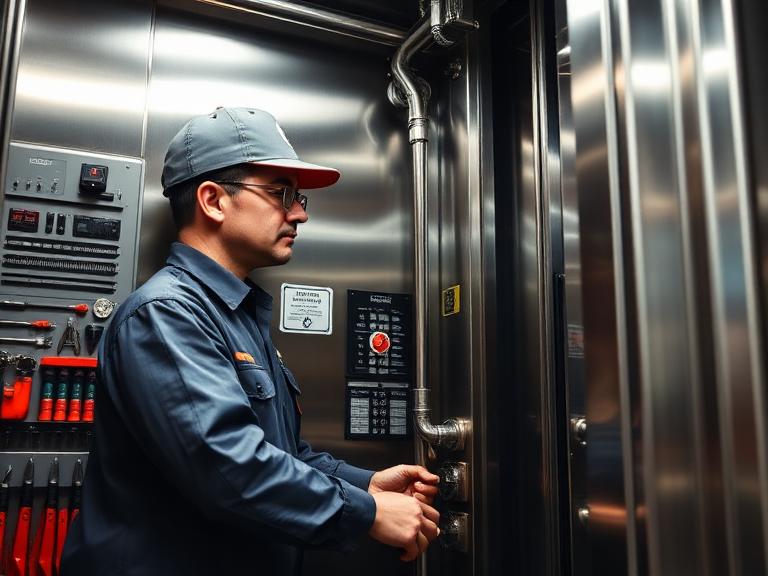
1. Anatomy of an Emergency Breakdown: Root Cause Analysis
When an elevator system locks up and drops out of service, the failure can usually be traced back to specific electrical, mechanical, or software safety triggers. Experienced field engineers categorize these failures systematically to narrow down the search area.
A. Safety Loop Interruptions and Open Circuits
An elevator’s safety string is a continuous series of low-voltage electromechanical switches wired together in a closed loop. If any single switch in this loop opens, the central logic controller drops power to the primary drive motor and applies the mechanical brakes instantly.
- Governor Over-Speed Switches: If an electrical surge or mechanical failure causes the car to travel faster than its rated velocity, the over-speed governor trips its safety switch to halt power before physical runaway occurs.
- Pit Buffer Safety Switches: Heavy vibration or structural stretching can cause the safety switches mounted to the pit shock buffers to trip, indicating a false or real over-travel condition.
- Terminal Limit Overruns: If an elevator car travels past its top or bottom landing zones, it physically strikes a mechanical terminal limit switch, breaking the safety loop to prevent a structural collision.
B. VVVF Drive and Electronic Power Unit Inversions
The Variable Voltage Variable Frequency (VVVF) inverter drive is the brain behind modern permanent magnet synchronous motor (PMSM) traction lifts. High-load operating conditions during hot summer months frequently push these power units to their limits:
- Overcurrent and Thermal Trips: If an elevator car is consistently overloaded, or if shaft guide rails are poorly lubricated, the drive motor must draw extra current to move the load. This extra strain generates intense thermal energy, causing the inverter’s insulated-gate bipolar transistor (IGBT) modules to execute an emergency thermal shutdown.
- Motor Encoder Feedback Errors: The digital encoder tracks the exact speed, direction, and position of the motor shaft down to the millimeter. If the encoder cable picks up electrical noise or suffers a loose connection, the drive loses its position reference and locks out the system immediately to prevent leveling errors.
2. Emergency Passenger Rescue and Mechanical Evacuation Protocols
The absolute first priority during an emergency elevator breakdown is the safe evacuation of any trapped passengers. Field technicians follow strict, step-by-step safety sequences to perform a manual rescue without risking injury.
1.Main Utility Power Isolation and Lockout-Tagout (LOTO):Phase I.
Before approaching any mechanical drive elements, the technician must enter the machine room or controller area and switch off the main 3-phase power breaker. They apply a physical lockout padlock and warning tag to guarantee the system cannot restart accidentally while manual rescue work is underway.
2.Establish Cabin Communication and Verify Passenger Status:Phase II.
The technician uses the intercom system or stands at the landing doors closest to the stalled car to communicate with the passengers inside. They reassure the occupants, instruct them to remain calm away from the doors, and confirm that no medical emergencies require immediate emergency services.
3.Locate Cabin Position Inside the Hoistway Shaft:Phase III.
The engineer checks the controller’s diagnostic panel or looks for physical floor-level marks painted onto the steel hoisting cables. This step determines exactly how far the stalled car is from the nearest landing zone and verifies if the counterweight is safely balanced.
4.Execute Controlled Manual Brake Release (Drifting):Phase IV.
Using a dedicated mechanical brake release lever provided by the manufacturer, the technician carefully opens the motor brake calipers in short, controlled bursts. Gravity pulls the heavier side—either the car or the counterweight—allowing the cabin to drift slowly toward the nearest floor landing.
5.Verify Perfect Floor Level Alignment:Phase V.
The technician drifts the car slowly until the cable marks or diagnostic indicators confirm the cabin floor is perfectly flush with the building’s landing sill. They release the brake lever to lock the car firmly in place before attempting to open any doors.
6.Engage Emergency Landing Door Release Key:Phase VI.
The engineer inserts a specialized tri-lobe or double-pin emergency drop key into the safety release hole on the landing door panel. They turn the key to mechanically release the interlock mechanism, slide the landing and cabin doors open by hand, and assist the passengers out safely.
3. Advanced Electrical Troubleshooting: Systematic Fault Isolation
Once passengers are clear, the breakdown technician transitions to electrical troubleshooting to locate and resolve the root cause of the system failure.1. Primary Inbound Power Auditing
The technician uses a digital multimeter set to Alternating Current (AC) mode to measure voltage across the primary incoming phases ($L_1, L_2, L_3$). In many urban areas, grid power can fluctuate during peak demand periods. The technician verifies that phase-to-phase voltage reads a stable $415\text{V}\text{ AC} \pm 10\%$. If a phase voltage drops too low, or if a phase is lost completely (single-phasing), the drive will lock down to prevent motor burnout.
2. Safety String Segment Mapping
Instead of checking every individual switch across multiple floors, the technician checks specific diagnostic terminal strips inside the main controller cabinet. The safety loop is divided into clear segments.
By measuring DC voltage at these main segment terminals, the technician can quickly isolate the failure. For example, if a 24V DC signal is present at the hoistway limit input but drops to 0V at the landing door terminal, the technician knows the fault lies within a door interlock switch somewhere along the shaft.
3. CAN-Bus Protocol Interrogation
Modern elevators use a Controller Area Network (CAN-bus) to transmit serial data between the main controller, the car operating panel, and individual floor landing indicators. The technician uses a portable digital storage oscilloscope or a specialized software interface tool to look for communication errors.
If they spot jagged signal lines or excessive electrical noise on the CAN-high and CAN-low lines, they know a data packet corruption is occurring. This is usually traced back to worn traveling cables, a loose grounding wire, or moisture ingress inside a shaft junction box.
4. Technical Comparison: Emergency Failure Modes and Repair Timelines
The time required to resolve an elevator breakdown depends heavily on whether the root cause is a simple mechanical misalignment or a catastrophic electronic failure.
Elevator Breakdown Intervention Guide
| Specific System Failure Mode | Primary Root Cause Component | Required On-Site Tooling | Average Resolution Window | Critical Safety Actions Needed |
| Complete Safety Loop Lockout | Corroded or dirty copper contacts inside a landing door interlock switch. | Digital multimeter, contact cleaning fluid, abrasive wire brush. | 30 to 45 Minutes | Clean or replace individual switch modules; verify safety string loop continuity. |
| ARD Failure During Power Cut | Degraded lead-acid battery cells or a burned-out battery charging circuit board. | Battery load tester, insulated hand tools, replacement battery blocks. | 1 to 2 Hours | Isolate the system; swap out failed battery cells; test backup rescue sequences. |
| VVVF Inverter Drive Blowout | Catastrophic failure of an IGBT power transistor due to voltage spikes or overheating. | Electrostatic discharge (ESD) wrist strap, torque drivers, replacement OEM drive. | 3 to 5 Hours | Run full parameter backups; swap out the drive module; recalibrate the motor tuning. |
| Hoistway Final Limit Overrun | Failure of a primary directional contactor or braking deceleration switch. | Heavy-duty mechanical rail clamps, hoisting chain blocks, specialized hand tools. | 2 to 4 Hours | Mechanically clamp the car; hand-wind the machine back into normal travel limits; replace failed switches. |
| Traveling Cable Ribbon Break | Copper conductor fracture caused by long-term bending fatigue inside the cable bundle. | Replacement high-flex ribbon cable, wire stripping tools, heat-shrink tubing. | 4 to 8 Hours | Fish a new cable run through the hoistway path; secure bundle loops; run terminal continuity audits. |
5. Regulatory Safety and Compliance Mandates under State Laws
Operating vertical transportation systems comes with strict legal and safety responsibilities. Property owners must ensure their elevators comply with local safety frameworks to protect passengers and avoid legal liabilities.
Statutory Safety System Benchmarks
- The Telangana Lifts Framework Compliance: All passenger and material lifts operating across the state must comply with strict rules enforced by the Chief Electrical Inspectorate to Government (CEIG). If an elevator is found running with an expired operation permit or using unlicensed mechanics for critical repairs, authorities can issue immediate shutdown orders and level stiff financial fines.
- Mandatory Automatic Rescue Device (ARD) Integration: State safety guidelines make it mandatory for all passenger elevators to feature an operational ARD system. This safety module must be tested monthly to ensure it can automatically move a stalled car to safety during a utility power outage without human intervention.
- Accident Reporting Laws: If a serious mechanical failure or passenger injury occurs, building management is legally required to isolate the site and notify the CEIG within 24 hours. The elevator must remain out of service until a state inspector conducts a full technical safety audit and issues a formal clearance certificate.
6. Proactive Risk Management: Sourcing a Qualified Breakdown Partner
When a critical breakdown occurs, relying on uncertified local mechanics introduces major operational and safety risks. Facility managers should screen emergency service providers using clear technical criteria.
Critical Evaluation Checklist for Property Managers
- Verify Licensing and Certifications: Ensure the breakdown team holds a valid Class-A Electrical Contractor License from the state licensing board.
- Audit Emergency Response Times: Look for service partners who maintain dedicated emergency crews within your local micro-market and can commit to a binding Service Level Agreement (SLA)—such as arriving on-site within 30 minutes for passenger entrapments.
- Confirm Genuine Spare Parts Inventories: Ensure the provider uses only genuine, manufacturer-approved components (such as contactors, safety switches, and drive boards) to maintain the integrity of your elevator’s safety system.
- Evaluate Advanced Diagnostic Capabilities: Verify that technicians are equipped with advanced diagnostic tools—including handheld OEM service interfaces, digital oscilloscopes, and insulation testers—to ensure fast, accurate troubleshooting.
7. Frequently Asked Questions (FAQs)
Q1: Why does a lift controller log a ‘Phase Reversal’ fault, and how do technicians resolve it?
A: A phase reversal fault is a safety lockout triggered when the order of incoming 3-phase utility power lines changes. This can happen after utility grid repairs or a generator swap. If left uncorrected, the motor would spin in the wrong direction, driving the car up when it should go down. A technician resolves this by checking phase rotations with a meter and swapping two incoming power lines at the main breaker to restore proper direction.
Q2: What causes an elevator car to shut down exactly at the top or bottom terminal landings?
A: This issue is typically caused by a failure in the deceleration system or stretching of the suspension cables. If the lift travels into a landing zone too quickly, or if stretched cables cause the car to sit slightly lower than expected, the cabin frame will physically strike the mechanical final limit switch. This action breaks the safety loop instantly, requiring a technician to attach hoist blocks and hand-wind the car back into normal travel limits before they can reset the system.
Q3: How do technicians diagnose intermittent safety loop failures that disappear after a reset?
A: Intermittent safety loop faults are often caused by loose wiring terminations, worn door lock rollers, or high-vibration areas like the car gate switch. Technicians troubleshoot these issues by connecting a data-logging diagnostic tool to the controller to record voltage changes in real time. They also manually shake door panels and wiggle wiring harnesses along the shaft to locate the loose connection or worn switch mechanism causing the drop.
Q4: What is the normal service lifespan of an Automatic Rescue Device (ARD) battery pack?
A: Standard Sealed Lead-Acid (SLA) battery blocks used in ARD systems typically provide a service life of 2 to 3 years. Their lifespan depends heavily on the ambient temperature in the machine room and the quality of the charging circuit. Because high ambient heat accelerates internal battery degradation, technicians use specialized load testers during routine checks to replace weak cells before they fail during a power cut.
Q5: Can a building’s lightning protection system influence elevator operation?
A: Yes. If a building encounters a direct lightning strike or a severe power surge, the intense electrical energy can pass through local grounding lines and travel into the elevator’s logic panels. This surge can corrupt memory chips, burn out communication transceivers, or completely destroy the sensitive IGBT modules inside a VVVF drive. Installing dedicated surge protection devices (SPDs) on incoming power lines helps isolate electronics from these high-voltage spikes.