Table of Contents
DevOps Transformation for Enterprises | Sandhata
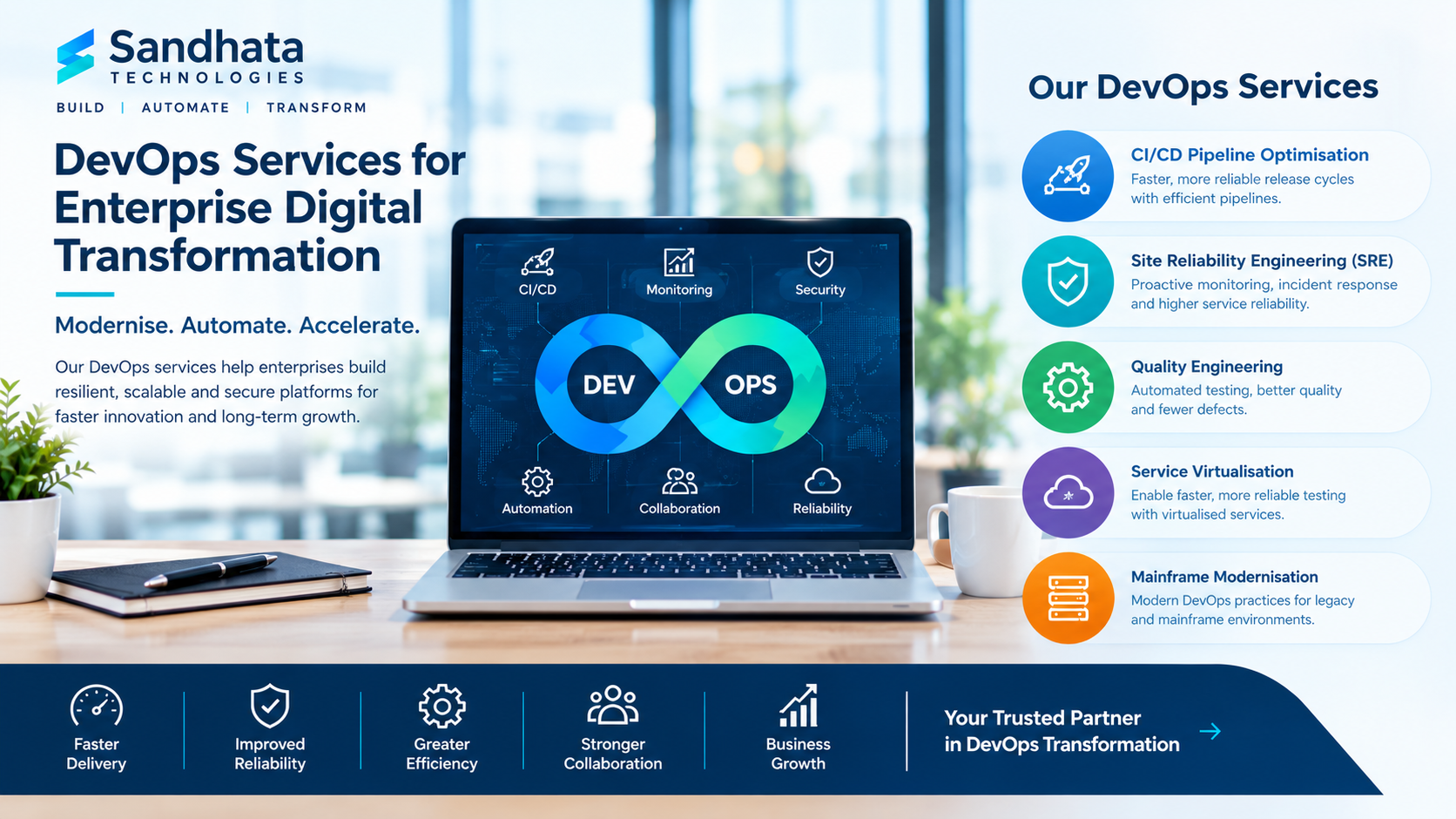
Enterprise organisations depend on software to manage business operations, deliver digital services and respond to changing customer expectations. As technology environments expand, software delivery can become increasingly difficult to coordinate. Multiple development teams, legacy applications, cloud platforms, security controls and manual deployment procedures may create delays and operational challenges.
These issues cannot always be resolved by introducing a new tool or automating a single process. Sustainable improvement requires changes to the way teams develop, test, release and operate software.
DevOps Transformation for Enterprises is the process of improving software delivery across an organisation by aligning people, processes, technology and governance. It helps enterprises establish more consistent engineering practices, improve collaboration and create repeatable workflows that suit their technical and operational requirements.
For large organisations, transformation also involves balancing delivery speed with software quality, security, regulatory obligations and service reliability. A successful approach must account for existing systems while allowing teams to adopt better practices progressively.
This guide explores the practical stages of enterprise DevOps transformation, the capabilities organisations should prioritise, common implementation challenges, useful performance measures and ways to sustain improvements over time.
What Is DevOps Transformation for Enterprises?
DevOps transformation is an organisation-wide or team-level improvement programme that connects software development and IT operations through shared responsibilities, automation, feedback and repeatable processes.
Traditional delivery models may separate development, testing, release management and operations into distinct stages. Although separation can provide specialised expertise, excessive handovers can create delays and make it difficult to identify responsibility when problems occur.
DevOps encourages closer collaboration throughout the software lifecycle. Development teams consider operational requirements earlier, quality engineering becomes part of the delivery process, and operations feedback helps inform future development decisions.
For enterprises, the transformation may include:
- Reviewing current software delivery processes.
- Standardising suitable CI/CD workflows.
- Improving test automation and quality engineering.
- Automating infrastructure provisioning.
- Integrating security into development pipelines.
- Establishing monitoring and incident response practices.
- Improving collaboration across engineering teams.
- Modernising delivery practices for legacy applications.
- Measuring delivery performance and service reliability.
The precise scope depends on the organisation’s size, architecture, objectives and existing capabilities. Some enterprises may begin with a single application or business unit, while others may coordinate improvements across several engineering teams.
The central objective is to establish a sustainable delivery model that supports the organisation’s business and technical requirements.
Why Enterprise Organisations Are Adopting DevOps Transformation
1. Increasing software delivery complexity
Enterprise applications frequently depend on shared services, databases, APIs, infrastructure platforms and third-party integrations. A change in one component can affect multiple systems.
Without coordinated release processes and clear ownership, teams may spend considerable effort resolving dependencies and preparing environments.
DevOps transformation helps organisations improve visibility across the delivery lifecycle and establish repeatable ways to build, test and release changes.
2. Reducing unnecessary manual work
Manual configuration, repetitive testing, environment preparation and deployment activities can consume engineering time and introduce inconsistency.
Automation can help reduce repetitive tasks when the underlying process is sufficiently understood and suitable for automation.
Enterprises should prioritise activities based on frequency, risk, implementation effort and maintenance requirements rather than automating every task indiscriminately.
3. Improving collaboration between teams
Development, testing, security and operations teams may have different priorities and measures of success. These differences can create friction when responsibilities and expectations are unclear.
A transformation programme can establish shared objectives, clarify ownership and introduce feedback mechanisms that help teams resolve problems collaboratively.
4. Strengthening software quality
Frequent software changes require reliable validation. If testing is inconsistent or heavily manual, teams may struggle to obtain timely feedback.
Automated tests, risk-based quality controls and consistent test environments can help identify defects earlier in the delivery process.
5. Supporting security and governance
Enterprise technology teams must often demonstrate that changes have been reviewed, tested and authorised appropriately.
DevOps transformation can incorporate security checks, access controls, traceability and approval processes into automated workflows. The objective is to integrate necessary controls without introducing avoidable delays.
6. Improving operational visibility
Software delivery does not end when an application is deployed. Teams need to know whether the service is performing as expected and how to investigate incidents.
Monitoring, observability and incident management help connect deployment activity with real operating conditions.
The Main Components of Enterprise DevOps Transformation
1. DevOps maturity and process assessment
Before changing existing workflows, enterprises need to understand their current capabilities.
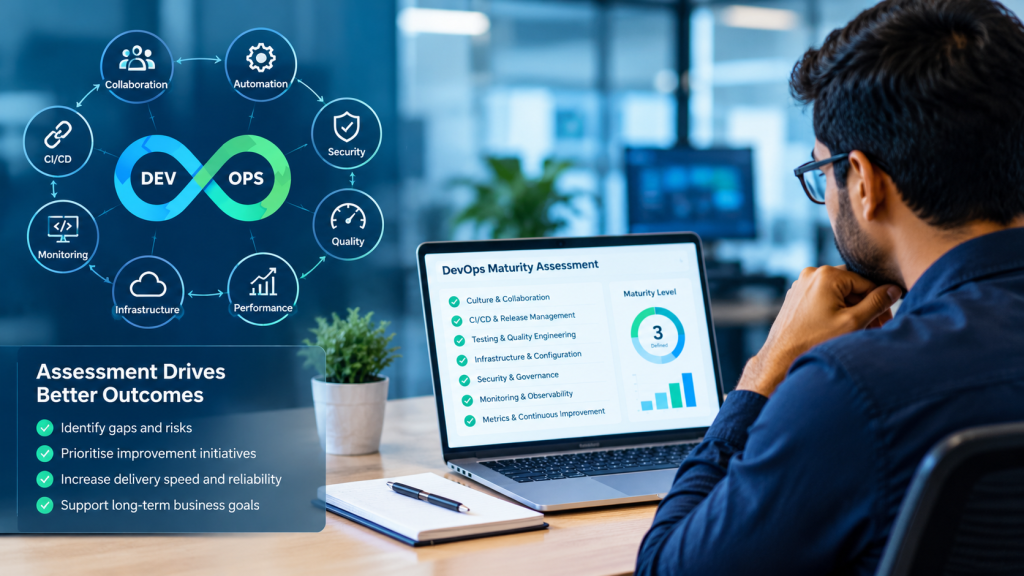
A maturity assessment may review source control, build automation, testing, deployment procedures, infrastructure management, security integration, monitoring and team responsibilities.
The assessment should use evidence from actual workflows wherever possible. Interviews, pipeline reviews, incident records and performance data can help reveal gaps that are not apparent from documentation alone.
The result should be a prioritised set of improvement opportunities rather than a generic recommendation to purchase additional tools.
2. Continuous integration and continuous delivery
CI/CD provides a repeatable approach to integrating code, validating changes and preparing software for release.
An enterprise CI/CD transformation may involve:
- Standardising appropriate pipeline components.
- Automating builds and test execution.
- Managing versioned build artefacts.
- Improving deployment consistency.
- Introducing environment validation.
- Integrating security checks.
- Managing approvals according to risk.
- Documenting rollback and recovery procedures.
Shared pipeline standards can reduce duplicated maintenance and make processes easier to understand. However, individual applications may still require specialised testing or deployment controls.
3. Enterprise test automation
Quality engineering is essential when organisations want to make software changes more frequently without compromising confidence in releases.
A suitable test strategy determines which checks should run at each stage. Unit and integration tests can provide early feedback, while broader regression, performance and end-to-end tests may be appropriate later.
Enterprises should also address test data, test-environment stability, flaky tests, coverage gaps and test maintenance.
A large collection of automated tests is not necessarily effective if those tests are unreliable or provide little useful feedback. The focus should remain on relevant coverage, maintainability and timely results.
4. Infrastructure automation and configuration management
Infrastructure as Code allows infrastructure definitions to be version-controlled, reviewed and applied through repeatable processes.
For enterprises, this can help establish consistent environments across development, testing, staging and production.
The transformation may include automated provisioning, configuration management, infrastructure validation, access management and secrets handling.
Organisations should define ownership for shared infrastructure and establish suitable controls for changes affecting critical systems.
5. DevSecOps implementation
Security should be considered throughout the software lifecycle rather than left entirely to a final review.
Depending on application requirements, DevSecOps practices may include:
- Static application security testing.
- Software dependency analysis.
- Secrets detection.
- Container image scanning.
- Infrastructure configuration checks.
- Security testing and vulnerability management.
- Role-based access controls.
- Traceable security exceptions.
The strategy should define how findings are prioritised, who owns remediation and which conditions prevent a release.
Security controls must be proportionate to risk. Poorly configured checks can create unnecessary bottlenecks, while insufficient controls can allow avoidable vulnerabilities to progress.
6. Monitoring, observability and SRE
Monitoring and observability help teams understand application behaviour and investigate operational problems.
Enterprises may need appropriate logs, metrics, traces, dashboards and alerts for their critical services.
Site Reliability Engineering (SRE) can complement these practices through service-level indicators, service-level objectives, error budgets and structured incident reviews.
The appropriate approach depends on service criticality, user expectations and the organisation’s operational capacity. Reliability measures should be meaningful for the service rather than adopted as a checklist.
7. Legacy application delivery improvement
Legacy applications often present specific challenges, including limited test coverage, tightly coupled components, specialised deployment procedures and dependencies on older infrastructure.
These systems may still support important business processes, so replacing them immediately may not be practical.
Enterprises can often begin by improving version control, build repeatability, regression testing, deployment documentation and monitoring. More extensive modernisation can be considered where there is a clear business or technical justification.
The goal is to improve delivery practices while managing the risks associated with established systems.
A Step-by-Step Enterprise DevOps Transformation Framework
Step 1: Establish business objectives
Begin by identifying the outcomes the organisation expects from transformation.
These may include improving release predictability, reducing manual work, strengthening testing, increasing operational visibility or standardising practices across teams.
Objectives should be specific enough to guide decisions. Avoid defining success solely as the adoption of a particular platform or tool.
Step 2: Map the current delivery lifecycle
Document how changes move from development through testing, approval, deployment and production monitoring.
Include the dependencies between teams, systems and environments. Identify waiting periods, repeated activities, unclear responsibilities and common failure points.
This process provides a practical view of how software delivery works today.
Step 3: Prioritise high-value improvements
Not every process needs to change at once.
Evaluate improvement opportunities according to business impact, risk, implementation effort, dependencies and maintenance requirements.
For example, improving a frequently failing build pipeline may be more useful than introducing a new platform across every application.
Step 4: Define the target operating model
Establish how teams will collaborate, who will own delivery processes and which engineering standards should be shared.
The model may include pipeline conventions, testing expectations, deployment controls, platform responsibilities, security requirements and operational ownership.
It should provide enough consistency to support enterprise-wide governance without unnecessarily restricting application teams.
Step 5: Select a suitable pilot
Choose an application or team that can test the proposed changes under realistic conditions.
A useful pilot has a clear problem to solve, appropriate stakeholder support and measurable success criteria.
Avoid selecting a pilot solely because it is the easiest application to change. It should provide relevant lessons for future adoption.
Step 6: Implement and validate changes
Introduce the selected improvements and evaluate their performance.
Review pipeline reliability, test results, deployment consistency, security findings and team feedback. Record any issues that arise and adjust the approach before expanding it.
Step 7: Scale across teams
Once the pilot has been evaluated, develop reusable components, documentation and support processes.
Roll out changes in manageable stages. Provide training and make responsibilities clear so teams understand how to maintain the new practices.
Step 8: Maintain continuous improvement
Review performance measures regularly and update the transformation plan when business priorities, technical dependencies or risks change.
DevOps transformation should remain an ongoing engineering discipline rather than a programme that ends when the initial tools are installed.
Measuring the Success of Enterprise DevOps Transformation
Measurement helps enterprises determine whether changes are producing useful results. A balanced framework should consider delivery speed, stability, quality and operational outcomes.
Deployment frequency
This measures how often an application or service is deployed. Its interpretation depends on application requirements and release practices.
Lead time for changes
This measures the time between a code change being committed and reaching the relevant production environment, using a consistent definition.
Change failure rate
This measures the proportion of deployments that lead to a failure requiring intervention or remediation, based on defined criteria.
Failed deployment recovery time
This measures how long it takes to recover from a deployment-related failure.
These four measures are commonly associated with DORA’s software delivery performance research. Enterprises should interpret them together rather than optimise one measure in isolation.
Other relevant indicators include:
- Automated test reliability.
- Pipeline failure frequency and causes.
- Time required to provision environments.
- Vulnerability remediation time.
- Production incident impact.
- Service-level objective performance.
- Release approval waiting time.
- Engineering effort spent on repetitive operational work.
Metrics should help teams identify problems and learn from evidence. They should not encourage risky releases or compromise quality to meet arbitrary targets.
Common Challenges in Enterprise DevOps Transformation
Resistance to organisational change
Teams may be accustomed to established responsibilities, tools and approval processes. Clear communication, practical training and visible leadership support can help people understand the reasons for change.
Fragmented tools and workflows
Different teams may use incompatible platforms or maintain duplicated automation. Enterprises should assess the current tool landscape before deciding what to standardise, integrate or replace.
Unreliable automated tests
Flaky tests and unstable environments can reduce trust in automation. Test maintenance and environment reliability should be included in the transformation plan.
Legacy dependencies
Older applications may not support modern deployment patterns without additional engineering work. Improvements should account for architecture, operational requirements and business risk.
Excessive governance
Governance is important, but unnecessary approval steps can slow delivery. Review controls regularly and consider risk-based automation where appropriate.
Insufficient knowledge transfer
New tools and workflows are difficult to sustain when internal teams do not understand how they operate. Documentation, training and clear ownership should be included in the implementation plan.
How Sandhata Technologies Fits into Enterprise DevOps Transformation
Sandhata Technologies provides enterprise engineering and technology services across areas including DevOps and cloud-related capabilities, Quality Engineering, Site Reliability Engineering, service virtualisation, system integration and legacy modernisation.
These capabilities may be relevant when an organisation needs to improve delivery workflows across several connected areas. For example, CI/CD improvements may depend on automated testing, integration with existing systems and better operational visibility.
The appropriate scope should be based on the organisation’s current environment, business objectives and technical constraints. Enterprises evaluating external support should confirm the proposed deliverables, responsibilities, measurement approach and knowledge-transfer arrangements before beginning an engagement.
For organisations considering DevOps Transformation for Enterprises, the first step is to establish a clear picture of the current software delivery lifecycle and identify the improvements most likely to address their actual constraints.
Frequently Asked Questions
1. What is DevOps transformation for enterprises?
DevOps transformation for enterprises is the process of improving software development, testing, deployment and operations through collaboration, automation, shared practices and continuous feedback.
2. Why is enterprise DevOps transformation important?
It helps organisations address delivery bottlenecks, inconsistent workflows, manual processes and operational challenges while aligning engineering improvements with business requirements.
3. What are the main stages of enterprise DevOps transformation?
Common stages include defining objectives, assessing maturity, mapping workflows, prioritising improvements, piloting changes, validating results and scaling successful practices.
4. How does enterprise DevOps transformation differ from adopting DevOps tools?
Tool adoption introduces technology, while transformation also addresses processes, responsibilities, collaboration, governance and performance measurement.
5. What is the role of CI/CD in enterprise transformation?
CI/CD establishes repeatable workflows for integrating, testing and preparing software for release. It can improve consistency and reduce reliance on manual deployment steps.
6. Does enterprise DevOps transformation require cloud migration?
No. DevOps practices can be applied to cloud, on-premises and hybrid environments. Cloud migration should be assessed separately according to organisational requirements.
7. How does test automation support DevOps transformation?
Automated testing provides repeatable feedback on software changes. Effective test automation can help teams identify defects and make release decisions with better evidence.
8. What is DevSecOps?
DevSecOps integrates security practices into development and delivery workflows, including suitable security testing, access controls and vulnerability management.
9. Can legacy applications benefit from DevOps?
Yes. Legacy applications may benefit from improved version control, automated testing, repeatable builds, deployment controls and monitoring. Implementation must account for their technical constraints.
10. How long does enterprise DevOps transformation take?
The timeline varies according to scope, application complexity, existing capabilities, team readiness and organisational dependencies. Large-scale transformation generally requires phased implementation and ongoing improvement.
11. What metrics should enterprises track?
Useful measures include deployment frequency, lead time for changes, change failure rate, failed deployment recovery time, test reliability and service-level objective performance.
12. What is the purpose of a DevOps maturity assessment?
It establishes a baseline of existing practices and helps identify strengths, gaps, risks and opportunities for improvement.
13. How can enterprises improve collaboration between development and operations?
They can establish shared objectives, clarify service ownership, reduce unnecessary handovers, document responsibilities and create regular feedback mechanisms.
14. What role does Site Reliability Engineering play in DevOps?
SRE applies engineering practices to service reliability through approaches such as monitoring, service-level objectives, incident response and structured operational reviews.
15. Should every enterprise team use the same DevOps tools?
Not necessarily. Shared standards can improve consistency, but tooling should reflect architecture, integration requirements, security needs and operational support capabilities.
16. How can organisations reduce risk during DevOps transformation?
They can use focused pilots, risk-based prioritisation, automated testing, appropriate security controls, rollback planning and clear operational ownership.
17. What are common enterprise DevOps transformation challenges?
Challenges include fragmented tools, manual processes, unclear ownership, unreliable tests, legacy dependencies, governance bottlenecks and resistance to organisational change.
18. How should an enterprise choose a DevOps transformation partner?
Evaluate relevant experience, technical capabilities, security awareness, transparency, communication, practical implementation methods and knowledge-transfer plans.
19. How can an organisation sustain improvements after transformation?
Sustainability requires clear ownership, maintainable automation, documentation, training, regular reviews and continuous refinement of delivery practices.
20. How does DevOps transformation support digital transformation?
It can make software delivery more repeatable and responsive, helping organisations develop, release and maintain digital services in line with changing requirements.
21. What is infrastructure as Code in DevOps?
Infrastructure as Code is the practice of defining and managing infrastructure through version-controlled configuration or code. It supports repeatable provisioning and reviewable changes.
22. Can DevOps transformation improve release reliability?
It can help strengthen testing, deployment consistency, monitoring and recovery procedures. Actual results depend on the starting environment and how effectively the improvements are implemented and maintained.
Conclusion
DevOps transformation for enterprises is a coordinated effort to improve how software is built, tested, released and operated. It requires more than adopting new tools: organisations must align engineering practices, team responsibilities, security controls and operational processes with clearly defined objectives.
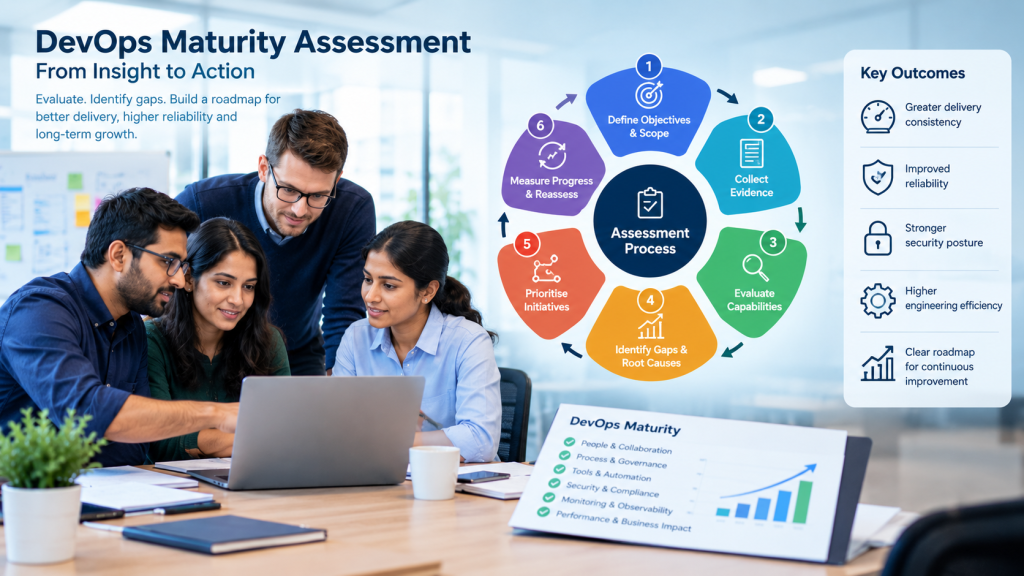
A practical transformation begins with an assessment of existing workflows, prioritises the most important constraints and validates changes through focused implementation. CI/CD, test automation, infrastructure management, DevSecOps and SRE can all contribute when selected according to the organisation’s needs.
By measuring outcomes, transferring knowledge and continuously refining practices, enterprises can establish a delivery model that is more consistent, maintainable and suitable for their operational requirements.
The most effective starting point is to understand the current environment, identify where delivery is constrained and create a realistic improvement plan that can be implemented progressively.