
Table of Contents
Online vs Offline Yoga (2025) — Global Comparison
Quick answer (snippet-ready):
Both online and offline yoga work — the best choice depends on your goals. Choose online for flexibility, affordability and habit formation; choose offline (studio/outdoor) for hands-on correction, deep immersion and community. Many learners get optimal results with a hybrid approach: regular online practice plus periodic in-person correction.
1. Why this comparison matters (global context)
Yoga is no longer a local pastime — by 2025 it’s a global wellness industry spanning:
- In-person studios, retreats and outdoor parks
- Live online classes and 1:1 sessions
- On-demand platforms and apps
- Teacher training (in-person & online)
- Corporate wellness programs
Users today ask a single practical question before choosing: “Which format will actually deliver results for my goals?” This guide answers that question clearly and gives practical, global-first advice while adding GEO context for Chennai, India.

2. Headline differences — the one-line comparisons
- Accessibility: Online > Offline
- Personalisation: Private offline ≈ Private online (1:1); group offline > group online for hands-on touch
- Cost (average): Online < Outdoor < Studio
- Community & immersion: Offline > Online
- Consistency / habit formation: Online ≥ Offline (if structured)
- Safety & injury risk: Offline (with certified teacher) < poorly run online — but quality online with live correction ≈ safe
3. Side-by-side table (fast snippet)
| Feature | Online Yoga | Offline Yoga (Studio/Outdoor) |
|---|---|---|
| Cost | Lower (group) | Higher (studio rental) |
| Convenience | Highest | Lower (commute) |
| Teacher correction | Live video correction / limited tactile | Full tactile correction & alignment |
| Batch sizes | Small to large | Often small (premium) |
| Community | Virtual | Strong in-person bonding |
| Atmosphere | Home/virtual | Controlled studio / nature (outdoor) |
| Best for | Beginners, busy pros, long-term habit | Deep immersion, therapeutic correction |
4. Deep dive — benefits of online yoga (what it really delivers)
4.1 Accessibility & flexibility
You can join from anywhere (city or remote). For people in time-constrained urban centers (e.g., Chennai IT corridors, NYC, London, Dubai), online removes the travel barrier.
4.2 Cost-effectiveness
Online group classes often cost 40–70% less than studio memberships. That means longer-term consistency for lower monthly spend — a major factor in successful practice.
4.3 Habit formation & frequency
Because online classes reduce friction (no commute), people attend more often — and frequency beats one-off intensity for long-term gains.
4.4 Variety & scale
You can sample different teachers, styles and time slots easily. Apps and platforms make cross-training (yoga + mobility + meditation) frictionless.
4.5 Privacy & comfort
Beginners and those with body-image concerns often prefer learning in private.

4.6 Hybrid and scalable learning
Good online providers offer recorded libraries + live correction, enabling fast skill consolidation.
5. Deep dive — benefits of offline yoga (studio & outdoor)
5.1 Hands-on correction & alignment
Nothing fully replaces a teacher’s tactile correction when learning complex alignment (backbends, arm balances).
5.2 Immersive environment
A dedicated studio or natural outdoor space provides atmosphere — sensory cues (sound, smell, light) that enhance focus. This is critical for meditative depth.
5.3 Community & accountability
Group energy, weekly meetups, and group rituals help retention. People join studios not just for technique but for social belonging.
5.4 Specialized therapy & safety
Therapeutic sessions (rehab, prenatal) often require in-person assessment. Medical collaboration is easier offline.
5.5 Retreats & depth practices
For intensive training or teacher training, the in-person format yields deeper embodiment and transformation.
6. Who benefits most from online — user archetypes
- Busy professionals (shift workers, IT)
- Parents with tight schedules
- People in areas with few studios
- Beginners craving privacy
- Budget-conscious learners
- People building long-term daily habits
7. Who benefits most from offline — user archetypes
- Serious practitioners seeking hands-on alignment
- People needing therapeutic, clinical-grade supervision
- People who thrive on group energy
- Retreat or immersion seekers
- Seniors needing in-person monitoring
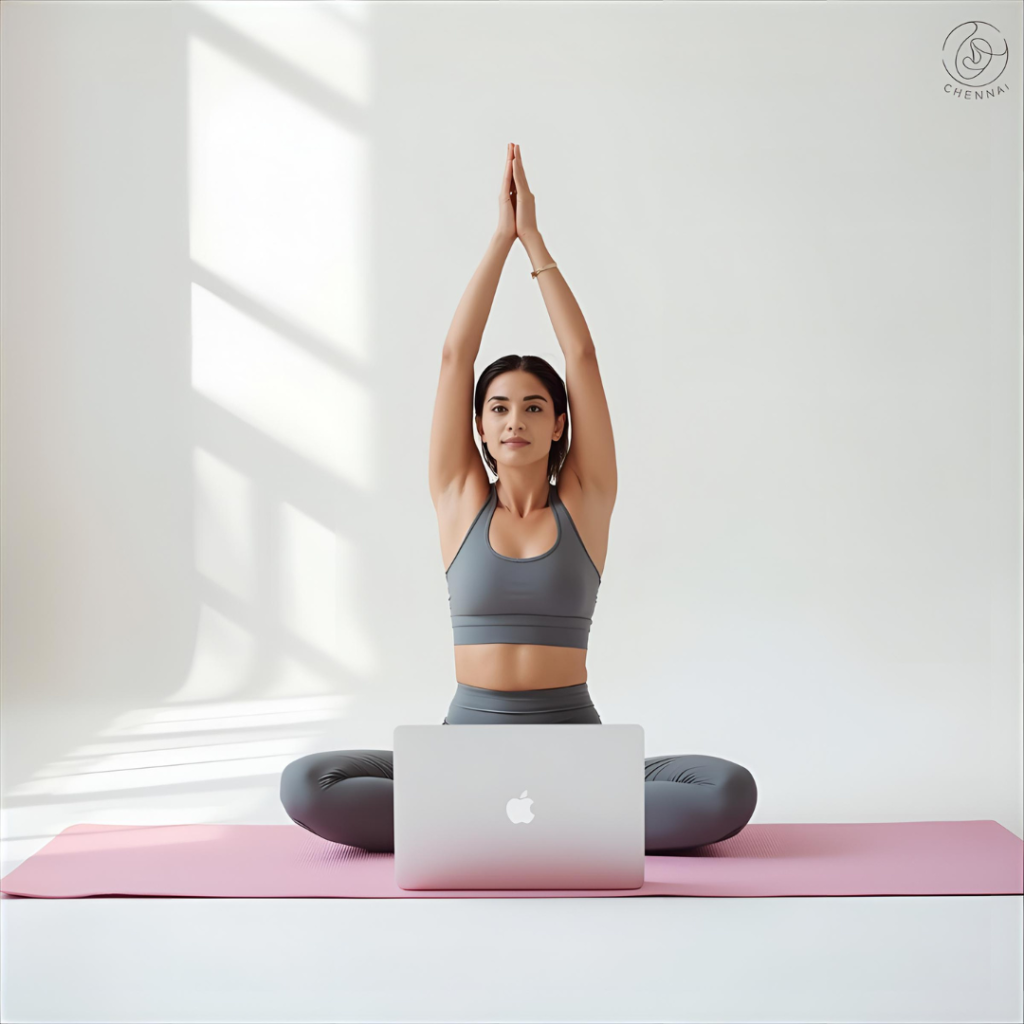
8. The hybrid secret — why most high performers combine both
Top performers follow this pattern:
- Start online to build habits and fundamentals (convenience + low cost).
- Periodically train in-person (monthly or quarterly) for hands-on correction and deeper adjustments.
- Use recordings to maintain technical notes from in-person corrections (teacher records cues).
This hybrid yields the highest ROI: near-daily practice + occasional expert recalibration.
9. How results differ — real metrics to watch (what success looks like)
When assessing which format delivers results, track these metrics over 3 months:
- Consistency (sessions/week) — strongest predictor of progress.
- Range of motion (flexibility tests) — measurable improvement by week 6–8.
- Pain levels / posture score — lower is better (use simple baseline assessments).
- Stress & sleep quality — self-reported scales improve with breathwork.
- Skill benchmarks — e.g., sustain a core pose, hold crow for X seconds.
Online wins for consistency; offline wins for quick correction-driven technique gains.
10. Cost comparison (global perspective, average ranges 2025)
(Prices vary by market, but ranges below are globalized and then shown with Chennai context.)
- Online (group): $8–$25 / month (₹700–₹2,000)
- Online (1:1): $15–$60 / session (₹1,500–₹5,000)
- Studio (group): $30–$120 / month (₹2,500–₹10,000)
- Studio (1:1): $25–$100 / session (₹2,000–₹8,000)
- Outdoor (group): $10–$40 / month (₹800–₹3,000) — varies widely by city & season.
Chennai note: outdoor & online options (like Outdoor Yoga Chennai) offer some of the best local value due to lower overhead and strong local teacher networks.
11. Technology & UX — what makes online actually work
A few tech/UX features separate poor online from excellent online programs:
- High-quality live video with multi-angle view (trainer + demo close-up)
- Low-latency audio & real-time chat for corrections
- Instructor camera checks & small class caps (≤12) to maintain visibility
- Recorded library + progress tracking
- Integrated assessment forms (posture, injuries, goals)
- Mobile-friendly flows and reminder systems to reduce no-shows
If your online provider has these — you’re likely to make great progress.
12. Safety: how to avoid injury online & offline
Online safety tips:
- Use a clear camera angle so teacher can see alignment
- Be honest about injuries / medical history
- Start with beginner batches — avoid advanced poses too soon
- Ask for modifications and rest options
Offline safety tips:
- Check trainer certifications and liability insurance
- Ask about class student-to-teacher ratio
- For therapeutic needs, choose a teacher with medical referrals
13. Evidence & learning outcomes — what studies suggest (high-level)
Numerous studies have shown yoga benefits for pain, flexibility, and mental health — and many telehealth studies show virtual exercise programs can match in-person outcomes if they include live coaching, feedback loops, and progress measurement. The takeaway: quality of instruction and consistency matter more than the medium itself.
14. Global cultural considerations (how yoga is taught across regions)
- India: strong tradition for in-person teacher lineage; rapid adoption of online for urban populations.
- North America & Europe: high penetration of hybrid programs and subscription models; studios focus on experience economy.
- Middle East & Southeast Asia: outdoor and online blend popular due to climate and commute patterns.
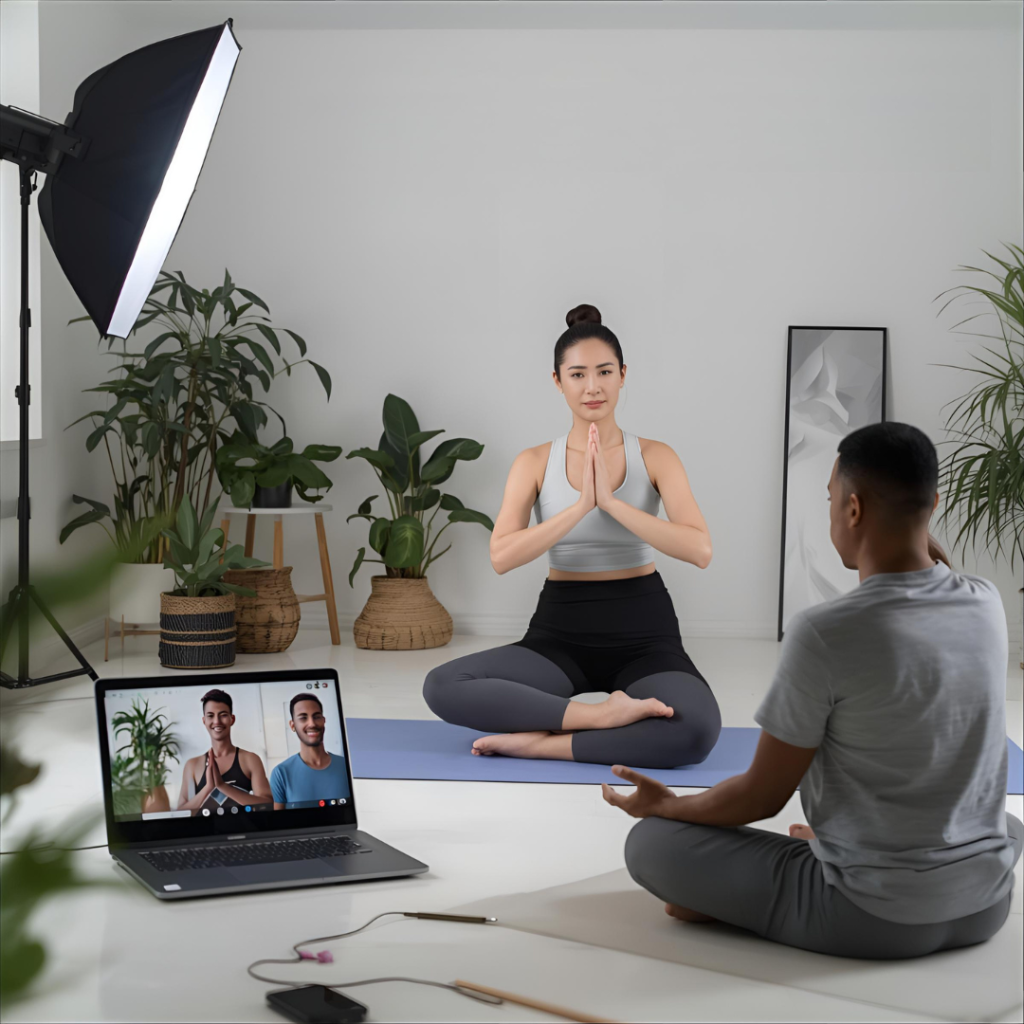
This global mix shows that hybridization is the dominant trend.
15. Practical guide — How to choose (decision flow)
- Define your primary goal (health, weight loss, therapeutic, teacher training).
- Choose format:
- Goal = habit & budget → start online
- Goal = therapy or depth → choose offline with periodic online for maintenance
- Check credentials: find certified teachers, read reviews.
- Sample both: take a week of live online + one studio class — gauge differences.
- Adopt hybrid: schedule in-person recalibration every 4–8 weeks.
16. Feature checklist — what a top provider should offer
- Small live class caps (≤12)
- Live posture checks & personal corrections
- Recording access
- Clear progress tracking & milestone benchmarks
- Specialised tracks (prenatal, therapy, seniors)
- Transparent pricing & trial classes
17. Local GEO note — Chennai & why Outdoor Yoga Chennai is relevant
Chennai’s urban rhythm — long commutes, coastal climate, and corporate hours — makes hybrid & online formats highly effective. For locals who want both nature-based practice and flexible online support, Outdoor Yoga Chennai provides:
- Multiple outdoor locations (Besant Nagar, Thiruvanmiyur, Kilpauk, Ampa Skywalk)
- Live online classes with local trainers who understand Chennai’s needs
- Trial classes, small groups, and hybrid options for best results
If you’re in Chennai, trying a hybrid model with a trusted local provider is the fastest route to results. Explore: https://outdooryogachennai.com/
18. Final verdict — which is better?
There is no absolute winner. The best choice depends on your goals:
- Choose Online if you prioritize convenience, long-term consistency, and budget.
- Choose Offline if you need hands-on correction, therapeutic care, or deep community immersion.
- Choose Hybrid (start online, recalibrate offline) if you want the highest ROI: consistency + expert correction.
For Chennai residents, a hybrid program that pairs outdoor sessions (for immersion & real-world correction) with live online follow-ups offers the highest practical value.
19. 30-day starter plan (hybrid blueprint)
Weeks 1–2: 3 online group sessions + recorded practice (30–45 min)
Weeks 3–4: 2 online + 1 outdoor/studio recalibration session (focus on alignment)
After 30 days: assess flexibility, pain, and energy levels → adjust plan.
20. Quick FAQs (snippet-ready answers)
- Q: Is online yoga as effective as offline?
A: Yes for habit-driven goals; offline gives faster technical refinement. - Q: Can I learn advanced poses online?
A: With a high-quality live coach and small class caps—yes; otherwise, do in-person training for advanced alignment. - Q: Which costs less?
A: Online group classes are cheapest; studios cost more due to overheads.
Closing: practical next step
If you want to start with a high-value hybrid — try a month of uninterrupted online practice, and then book an outdoor recalibration session. For Chennai readers, Outdoor Yoga Chennai offers a locally-tailored hybrid path: nature-based outdoor sessions + structured live online follow-ups. Check them at https://outdooryogachennai.com/.